How We Bought a Car in Australia in One Week (And What It Actually Cost Us)
We landed in Australia on a Friday. Nine days later we had keys, a rego in our name and an insurance policy.
That wasn't us being impressive. That was us being slightly panicked. We needed jobs, we'd picked a stretch of coast where you don't get jobs without a car, and our savings were doing that thing where you check the balance twice a day and it never goes up.
So this is the whole thing, honestly. Every dollar we paid, the bits we got right, and the two or three moments where I look back and wince a little. Our numbers are Queensland numbers, because that's where we bought, and Queensland does things its own way. Where the other states are different, I've said so.
If you read nothing else, read this: the price on the listing is not what you pay. The car was $5,900. We spent another $762 before we drove it anywhere useful. Budget for the second number or it will ruin your month.
Going deeper on one part? I've broken out the three sections people ask me about most: the full cost breakdown, the tips I'd give a friend and the inspection checklist you can take with you.
Why we didn't wait
Loads of people arrive and don't buy a car for months, and honestly they're often right. If your first two months are in Sydney or Melbourne, a car is just a thing you pay to park. The trains are good. Save your money.
We weren't in a big city. We wanted to be on the Sunshine Coast, which sounds like one place and is actually a string of towns stitched along the coast with a load of suburbs tucked in behind them. Caloundra, Mooloolaba, Maroochydore, Noosa. On a map it looks compact. On a bus it is not.
A trip that takes ten minutes in a car takes forty on public transport, when the route exists at all. That maths gets brutal when you're job hunting, because every trial shift and every walk-in with a résumé eats a chunk of your day. We'd have burned two weeks sitting at bus stops.
So we'd decided before we boarded the plane. What we hadn't figured out was the obvious problem: how do you go and look at cars when you don't have a car?
Rent something small for three days
We hired the cheapest little thing we could find for three days. Best money of the whole week, no contest.
Those three days got us four apartment viewings, three car inspections in three different towns, and a résumé run up and down the coast. Without it we'd have seen one car, maybe two, and we'd have talked ourselves into whichever one we saw first. That's exactly how people end up with a car that dies outside Bundaberg.
There's a psychological thing here too. When you're not stranded at a seller's house waiting for a bus, it's much easier to say "let me think about it tonight." Sellers can smell desperation. Don't smell of it.
Four things to sort before you look at a single car
Your licence
You can drive in Queensland on your home licence for as long as your visa is temporary and the licence is current. No three month deadline like the Northern Territory, no six months like New South Wales and Victoria. That's genuinely handy.
The catch is language. If your licence isn't in English, you need a recognised English translation and you need it on you. Queensland Transport points you at NAATI accredited translators. An International Driving Permit gets accepted in plenty of places, but Queensland's own guidance is written around the translation, so that's what I'd get. It's cheap, it doesn't expire, and it means you're not negotiating road law with a police officer on the Bruce Highway.
Get caught driving without valid authority here and it's charged as unlicensed driving, which can land you in court. Not the vibe.
An Australian bank account
Open it before you go shopping, not after.
And then do this, because it nearly caught me out: check your daily transfer limit. Mine defaulted to a number well below the price of a car. Raising it took about two minutes in the app settings. Discovering it while standing in a stranger's driveway with the deal already agreed would have been genuinely humiliating.
A budget with a buffer
We set $4,000 to $6,000 for the car. Then we ringfenced about $1,000 and pretended it didn't exist.
Please do this. A used car with 180,000 km on it is going to want something within six months, that's just what they do. If every dollar you own is inside the car, the first repair bill becomes a crisis instead of an irritation. We've met people who had to dump their car at a loss because a $900 job landed in the wrong week.
Understand rego before you look at anything
This is the one that catches out almost every new arrival, so it gets its own section.
Rego, and why it quietly changes the price of every car
"Rego" is Australian for vehicle registration. It's the state's record that this particular car is allowed on public roads, and it's what pays for the compulsory injury insurance.
Two things about it took me by surprise.
Rego is not proof of ownership. They're separate things. A registration certificate says who's responsible for the car, not who owns it. That's why a private sale is really two jobs, transferring the ownership and transferring the registration, and it's why you need a proper receipt no matter what the rego paperwork says.
Rego is expensive, and how much is left on the car is money in your pocket.
Here's what registration costs in Queensland for twelve months, as at 1 July 2026, straight from Queensland Transport. They index these every July so check before you rely on them.
| Component | 4 cylinder car | 5 to 6 cylinder car |
|---|---|---|
| Registration fee | $385.45 | $610.30 |
| Traffic improvement fee | $67.25 | $67.25 |
| CTP insurance | $411.80 to $424.80 | $411.80 to $424.80 |
| Total for 12 months | $864.50 to $877.50 | $1,089.35 to $1,102.35 |
Sit with that for a second. Registration on an ordinary four cylinder car is about $870 a year. That's not the car. That's permission to use it.
Now apply it to a listing. Two identical cars at $5,500, one with eleven months of rego left and one expiring next Tuesday, are not the same price. The first is roughly $800 cheaper in real terms. Almost nobody advertising a car will tell you that, and plenty of backpacker sellers haven't worked it out themselves.
So ask one question about every car you consider: when does the rego expire? You can check it against the plate on the Queensland Transport site instead of taking the seller's word for it.
A few other things worth knowing:
-
You can register for 1, 3, 6 or 12 months in Queensland. Short terms cost a bit more pro rata because there's a surcharge for the extra paperwork. We took 6 months, which felt right for a visa that might not run the full year.
-
Renewal is not automatic. A notice gets posted to you, but you will have moved house, because everyone moves house. Pay late and there's a $76.65 reinstatement fee on a 3, 6 or 12 month renewal.
-
Your CTP dies the second the rego lapses. CTP covers injuries you cause to other people, and nothing else. Without it, an at fault accident becomes your personal financial catastrophe in a country where medical bills are not gentle. Driving unregistered also gets you an on the spot fine in the hundreds, and a court can go up to 80 penalty units, which is $13,816 at Queensland's current penalty unit value of $172.70.
-
You can't move a rego between states. A New South Wales car does not become a Queensland car through paperwork. It has to be registered here from scratch. This matters more than you'd think, and I come back to it near the end.
What we were looking for, and where
Our filters were deliberately unexciting.
-
Under 200,000 km. Not because 200,000 is magic. Plenty of Toyotas are barely getting started. It just kept us in a price band where a mechanical failure wouldn't be the end of the trip.
-
Automatic. Most cars here are autos anyway, and if you're still adjusting to driving on the left, one less thing to think about is worth a lot.
-
2010 or newer. Better safety kit, and a service history that actually exists on paper.
-
$4,000 to $6,000.
We used three places:
-
Facebook Marketplace. Most listings, fastest sellers, most scams. Also where you find travellers with a flight booked, which is where the deals are.
-
Gumtree. Australia's classifieds site. Slower, more locals, listings that tend to be more honest.
-
Carsales. More dealers, better presented cars, and you pay for both of those things.
Facebook groups for travellers in Australia are worth joining as well. Just remember you're buying from someone with a departure date, which cuts both ways. Motivated to sell cheap, also motivated not to mention the noise the gearbox makes.
Everyone said buy Japanese or Korean
Toyota, Mazda, Honda, Nissan, Hyundai, Kia. We heard it from every single person we asked, and the reasoning isn't really about build quality. It's about what happens when something breaks.
Australia is enormous and mechanics are not spread evenly across it. If a Corolla drops a part in a town of 4,000 people, the local workshop has seen that part before and can probably get one tomorrow. If a Volkswagen Transporter loses its gearbox in the same town, you're looking at a specialist, a wait, and a bill that makes you feel unwell.
That's not hypothetical. It was the most common horror story we heard from other travellers, almost word for word every time. Lovely European van, automatic gearbox failed, weeks of hunting for anyone who could touch it.
Then research the exact model, not just the badge
Brand isn't enough. We got quite excited about a Jeep. Looked great, priced well, we were basically sold. Twenty minutes of searching that specific model and year turned up owner after owner complaining about the same brake fault. We walked away and felt very clever about it.
Do that search for every car before you drive out to see it. Model, year, and the word "problems." It's free and it's the best twenty minutes in this entire process.
Reading a listing properly
-
Priced well below everything comparable. There's always a reason. Occasionally the reason is a plane ticket. Usually it isn't.
-
The same listing reposted for weeks. Either the price is wrong or the car fails inspections.
-
A Facebook profile created last month with no friends and no history. Especially if they're vague about meeting in person.
-
Any request for a deposit before you've seen the car. Never. Not "just to hold it." Not ever.
-
A long list of recent repairs. This one's counterintuitive. A thick service history is a great sign. But five significant repairs in eight months means something is systemically wrong with that car. Ask for dates, not just a list.
Here's a question hardly anyone asks, and you should: if a recent repair is under warranty, does the warranty transfer? Plenty of Australian workshops guarantee parts and labour for a period. If the alternator was done two months ago, you might get a free second one. Ask for the invoice and the workshop's name.
The safety certificate, and the myth I keep hearing
I want to correct something that gets repeated constantly in traveller groups, because half of it is right and the other half will make you look like you've read one Facebook comment.
In Queensland the roadworthy inspection is officially a safety certificate. The actual rules:
-
It's the seller's job, not yours. Whoever transfers a registered vehicle to you has to give you a current safety certificate. Them. Not you.
-
The fee is $102.70 for a car up to 4,500 kg, as at 1 July 2026. It's set by the government, so anyone quoting you dramatically more is having a go.
-
It's valid for 2 months or 2,000 km from issue, whichever runs out first, for a private seller. Licensed dealers get 3 months or 1,000 km.
-
One certificate, one sale. No reusing it.
-
You cannot transfer the rego into your name without it. That's the practical crunch point.
-
A seller who skips it can be fined over $700.
Two bits of nuance that even locals get wrong.
A safety certificate is no longer required just to advertise a registered car in Queensland. That rule changed. So a seller who doesn't have one yet when you first message isn't automatically dodgy. They might just be waiting for a serious buyer before starting that two month clock, which is sensible.
"No roadworthy means it's a scam" is too strong. In Queensland, a seller with no intention of ever producing one is a problem, absolutely. But in Tasmania, Western Australia, South Australia and the ACT there is no legal obligation to provide any inspection certificate for a private sale at all. A Perth seller without a roadworthy is following the law. What you should take from that is more useful anyway: a car sold with no inspection requirement is a car you have to inspect yourself, at your own cost.
And the thing I'd tattoo on people if I could: a safety certificate is not a mechanical inspection. Queensland Transport says so themselves. It checks tyres, brakes, steering, suspension, rust, windscreen, lights. The stuff that makes a car safe today. It tells you absolutely nothing about whether the engine will survive the drive to Cairns.
The $2 check, which nobody should skip and loads of people do
Before you hand over money, run a PPSR check. Personal Property Securities Register, run by the federal government, costs $2.
You need the VIN or chassis number, which is on the car, and a card. It comes back in minutes and tells you whether:
-
the car has money owing on it. This is the big one. If the previous owner financed it and stops paying, the lender can repossess the car from you, after you've paid for it, and you have no comeback.
-
it's recorded as stolen.
-
it's been written off, and whether that was statutory (never legally registrable again) or repairable.
-
it's sitting on an unresolved safety recall.
Do it the day before or the day of, not a week early. You want the freshest record.
For another $15 to $25 you can buy a fuller history report with previous owners, odometer readings and reported incidents. On a $5,000 car that's a rounding error against the downside.
Looking over the car ourselves
We are not mechanics. What we did was the amateur pass, which is good for spotting obvious disasters and useless for making the final call.
I've put the full version in a separate inspection checklist you can screenshot and take with you, because you will forget half of it standing in someone's driveway trying to look knowledgeable. The short version:
Outside. Walk the whole body in daylight and sight along the panels from an angle, that's how you see ripples from a repair. Check rust at wheel arches, door sills and the boot floor, especially on anything that's lived near a beach. Run a fridge magnet over the panels: where it doesn't stick, there's filler hiding something. Windscreen chips. Tyre tread, and whether the wear is even, because uneven wear means alignment or suspension.
Under the bonnet. Oil level and colour, and milky is bad news. Any wet patches or crust. Then look at the ground where it's been parked, because fresh oil on concrete is a conversation.
Inside. Does the odometer match the wear? A 90,000 km car with a worn through driver's seat is telling you something. Test every light, both sets of wipers, all the windows, and the aircon. Take the aircon seriously, you're in Queensland.
Driving it. Listen on start up, watch for smoke. Gear changes should be smooth, because jerkiness in an auto is the most expensive noise a car can make. Brake hard somewhere safe. Get it above 80 km/h if you can, since problems love to hide at low speed.
Paperwork. The full service logbook. A complete, in order logbook is the best proxy for a careful previous owner that exists. Ask what it drinks, too, because a thirsty engine adds up fast over 20,000 km of road trips.
The pre purchase inspection, and the $110 I'd pay ten times over
Everything above is guesswork with confidence. Pay a mechanic.
A pre purchase inspection is a real mechanical assessment, the exact thing a safety certificate isn't. Usually $100 to $250. RACQ do them, and so will most independent workshops.
We got lucky on timing. The seller had to take the car to a workshop anyway to fix a window mechanism, so we rang that workshop and asked them to run a quick inspection while it was up on the hoist. $110. Came back clean. We bought it that week.
Two things I'd change. I'd pick the workshop myself instead of using the seller's, because that was luck dressed up as a decision. And I'd book it from the start rather than treating it as a happy coincidence. If a seller won't let a mechanic look at the car, that refusal is the answer.
The story that made me a believer, from a couple we met: they bought a 4x4, spent weeks fitting it out, drove off looking for farm work and broke down. Transmission gone. Around $9,000 to fix a car worth less than that. It went to the scrapyard and their savings went with it. They had had it checked, by someone the seller arranged.
Haggling
Australians are relaxed about it but not aggressive about it. What works:
-
Bring comparable listings on your phone. "There's a 2011 with 30,000 km less at $5,400" is an argument. "Can you do better?" isn't.
-
Use the inspection. If the mechanic flags $400 of tyres, that's $400 off or the seller sorts the tyres.
-
Use the rego. If it expires in three weeks, you're about to pay several hundred dollars. Say it out loud.
-
Don't get greedy on a genuinely good car in a hot market. We lost one to somebody faster while we were being tactical. On a $5,500 car, fighting over the last $200 for two days can cost you the car, and I still think about that one.
The day itself
We met at the seller's place and did it in this order.
Paperwork. In Queensland the registration transfer runs on form F3520, the Vehicle Registration Transfer Application. You both sign it. The buyer lodges their part, the seller keeps theirs as proof they're done with the car. You can do it all online through Queensland Transport, or in person at a service centre, a QGAP office out in the regions, a Magistrates Court, or some police stations.
You need at minimum the signed F3520, the current safety certificate from the seller, and proof of what you paid.
You have 14 days from the date of sale to lodge it. Miss it and you get late fees plus a car that's still legally someone else's, including their tolls and their speeding tickets.
Payment. I used PayID from my Australian account. Seconds to land, and it can't be reversed the way a cheque can. Three things that saved us:
-
Raise your daily transfer limit the day before. Defaults are often under $5,000.
-
Send $1 the day before as a test. New payees sometimes need verifying, and a tiny transfer flushes that out while there's still time. It also confirms the account details are right before you fire five grand into the void.
-
Get a receipt. Handwritten is fine. It needs the date, the price, the make, model, VIN and rego, the seller's full name and address, and both signatures. That's your proof of ownership and your proof of price for duty.
Never pay a deposit to someone you haven't met. And if you ever end up selling, know the classic reverse scam: a buyer "accidentally" overpays and asks you to refund the difference, then the original payment turns out to be stolen and the refund was real money.
What it cost us
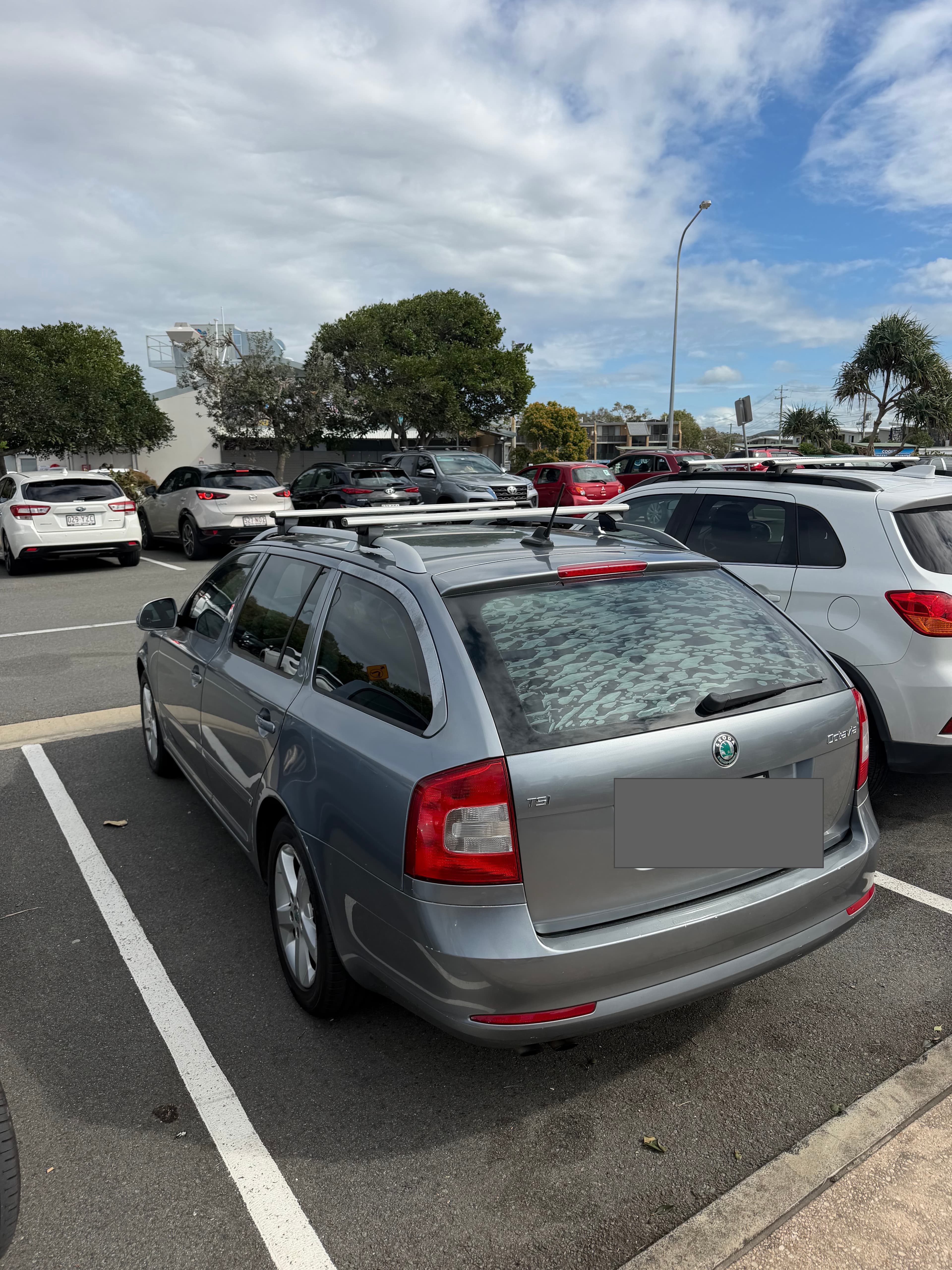
A 2012 Skoda Octavia, four cylinder, bought for $5,900 in Queensland.
| What | Amount |
|---|---|
| The car | $5,900.00 |
| Pre purchase mechanical inspection | $110.00 |
| PPSR check | $2.00 |
| Safety certificate | $0.00 (seller's obligation) |
| Rego transfer fee | $33.65 |
| Vehicle registration duty | $177.00 |
| Rego renewal, 6 months | about $440.00 |
| Total before insurance | about $6,662.65 |
| Car insurance, third party property | [your figure] |
| Three day car rental | [your figure] |
How the duty was worked out
Queensland charges vehicle registration duty on the dutiable value of the car, meaning the price you paid or the market value, at a rate based on cylinders.
| Vehicle type | Rate on value up to $100,000 |
|---|---|
| Hybrid or electric, any cylinders | $2 per $100 |
| 1 to 4 cylinders | $3 per $100 |
| 5 or 6 cylinders | $3.50 per $100 |
| 7 or more cylinders | $4 per $100 |
Ours: $5,900 divided by $100 is 59, times $3 equals $177.
Look at what that table does to your shortlist. A six cylinder car at the same price costs $206.50 in duty instead of $177, and roughly $225 a year more in registration. In Queensland, cylinders are a recurring bill, not a one off.
Also, and people do try this: putting a lower number on the receipt doesn't reduce your duty. It's assessed on price or market value.
There's a much fuller version of all this, including the costs nobody warns you about in the first month, in the complete cost breakdown.
Insurance
CTP, the bit bundled into your rego, covers injuries to other people. That is the entire scope. Not their car, not your car, not the fence you reverse into.
So a second policy is worth having. The tiers:
-
Third party property only. Covers damage you do to other people's cars and property. Cheap. On an old car this is the sensible floor, because the thing that would actually destroy you financially isn't losing your $5,900 Skoda, it's writing off somebody's new Ranger.
-
Third party fire and theft. Adds a bit of cover for your own car.
-
Comprehensive. Covers your car too. Rarely worth the premium on a cheap vehicle, and insurers often won't offer much on one anyway.
We went third party property. Get quotes with your real address and age, both of which move the number a lot, and brace yourself if you're young and on a temporary visa.
While you're there, check whether your travel or WHV health insurance already includes private liability cover. Most do, and it's separate from anything car related.
Our nine days
-
Friday. Landed.
-
Saturday. Picked up the hire car, started messaging sellers, booked viewings.
-
Sunday to Tuesday. Apartment viewings, three car inspections, résumés up and down the coast.
-
Wednesday. Shortlisted one car, researched the model, ran the PPSR check.
-
Thursday. Pre purchase inspection at the workshop. Clean.
-
Friday. Test dollar sent, transfer limit raised.
-
The week after. Paid, signed the F3520, got the receipt, lodged the transfer, renewed the rego for six months, sorted insurance.
Nine days. The only part that felt genuinely rushed was the apartment, and that's a different article.
If you're not buying in Queensland
Every state runs its own registration system and the differences cost real money. The figures below were published in early 2026 and most states index annually, so treat them as ballpark and confirm with the state authority before you commit.
| State | Transfer deadline | Transfer fee | Inspection needed for a private sale? |
|---|---|---|---|
| Queensland | 14 days | $33.65 | Yes, safety certificate, seller provides |
| New South Wales | 14 days | about $41 (about $188 late) | Annual pink slip if over 5 years |
| Victoria | 14 days | about $46 | Yes, RWC, valid 30 days |
| Western Australia | 14 days | Weight based formula | No |
| South Australia | 14 days | about $31 (about $105 late) | No |
| Tasmania | 14 days | about $34 | No |
| Northern Territory | 14 days | about $21 | Annual inspection over 5 years, then 10 |
| ACT | 14 days | about $50 (about $134 late) | Inspection on transfer if over 6 years |
Two traps in that table.
Buying a car registered in another state can wreck your week. If online transfer isn't available for that state, you may have fourteen days to physically get yourself to a service centre in the state where the car is registered. If you're in Cairns and the car's registered in Adelaide, that is not going to happen. Buy locally, or confirm online transfer works first.
No inspection requirement means more risk, not less admin. Western Australia, South Australia, Tasmania and the ACT don't make the seller prove anything about the car's condition. Those are exactly the places where paying for your own inspection stops being optional.
What I'd do differently
Pick the mechanic myself. Ours worked out fine. It still shouldn't have been the seller's workshop.
Ask about the rego expiry in the very first message. We drove out to see a car whose rego had three weeks left, which changed the real price by about $700 and killed the deal in the driveway. Wasted afternoon.
Take the brand advice more seriously. Everyone told us Japanese or Korean and we bought a Czech car. It's been completely fine and we did our homework on the model. But every time it makes a sound I don't recognise, I think about parts availability, and I wouldn't have that particular low hum of anxiety in a Corolla.
Photograph everything at handover. Odometer, all four corners, the existing dents, the signed receipt. Do it on the day. You'll want it when you sell, and you'll really want it if anything ever gets disputed.
FAQ
Can you buy a car in Australia on a working holiday visa?
Yes. There's no residency requirement to buy or register a vehicle. You need an Australian address for the registration, a licence you're entitled to use, and a way to pay.
Do I need an Australian driver's licence?
Not on a temporary visa. Your home licence works in Queensland for as long as your visa is temporary and the licence is current. Carry a recognised English translation if it isn't in English.
How much does it cost to buy and run a car in Queensland?
On top of the purchase price, budget the transfer fee of $33.65, duty at $3 per $100 of value for a four cylinder, and registration at around $870 a year. Then insurance, fuel, and a service every six months or 10,000 km.
Who pays for the safety certificate in Queensland?
The seller. It's their legal obligation when transferring a registered vehicle and they can be fined over $700 for not providing one. The government set fee is $102.70 for a car.
How long do I have to transfer the rego in Queensland?
Fourteen days from the date of sale. Late transfers attract fees, and until it's lodged the car stays legally attached to the seller.
Is a safety certificate the same as a mechanical inspection?
No, and this is the mistake that costs people the most. A safety certificate checks whether the car is safe on the road today. It says nothing about the engine or gearbox. Pay separately for a pre purchase mechanical inspection.
What's the best car to buy for a working holiday?
Something common, Japanese or Korean, automatic, with a documented service history. A Corolla, a Mazda 3, a Hyundai i30. Boring is the whole point, because parts are everywhere and every mechanic in the country has fixed one.
Can I transfer a rego from another state to Queensland?
No. Registration can't move between states. A car registered elsewhere has to be registered in Queensland from scratch, which means a safety certificate and the full registration cost.
The short version
Buying the car was the most stressful week of our arrival and also the thing that unlocked everything after it. The jobs, the apartment, the weekends where you drive an hour north and there's nobody on the beach.
If a friend landed on a Friday, here's what I'd tell them. Rent something cheap for three days so you're not desperate. Learn what rego costs before you open a single listing, and ask every seller when it expires. Search the exact model and year for known faults. Spend $2 on a PPSR check and $110 on a mechanic, and don't let the seller choose the mechanic. Raise your transfer limit and send a test dollar. Get a receipt with the VIN on it. Lodge the transfer inside fourteen days.
And keep $1,000 out of the car. You will need it, and you'll be very smug when you do.
Fees and rules here were checked against Queensland Government sources in August 2026. Queensland indexes transport fees every 1 July and CTP premiums are reviewed quarterly, so confirm the current numbers with Queensland Transport before you budget.